Hazrat Bahar, in 30s, was born in Khost province in Afghanistan. He was working as a lecturer at Shaikh Zayed University and freelance communications specialist. He left Afghanistan after the Taliban took over his country. Although Hazrat had prior experience in Germany, this time it was different for him. “Back in 2016, I was on a research trip to Germany organized by Deutsche Welle Akademie. It was a well-planned trip, and I did not have to do more myself. When I returned the second time, I had to look after everything on my own. We landed in Hanover in the late evening. After going through the immigration process, we went to Düsseldorf for a week and finally moved to Arnsberg in North Rhine-Westphalia. The first few days were a bit difficult because we didn’t know exactly what was planned, but once we found out and moved to Arnsberg, I took charge of getting settled in and beginning the process of integration into German life. Generally, I think that compared to other countries, things in Germany run smoothly.”
Hazrat believes that finding employment in a specific profession can be a great challenge for many people, but he thinks that networking and being passionate can help one find a way. “I was invited by a German organization – MiCT, to an annual conference in Berlin. I was able to build a network of peers in academia. That helped me to work first as a freelance researcher. Now, I have a full-time contract with Leipzig University, and my work is also partially supported by the Institute of International Education.” Hazrat is a postdoctoral research fellow at Leipzig University.
His life proceeds normally and smoothly. Nevertheless, “life far away from my homeland, where I grew up, spent my childhood and left behind friends and dearest ones, can be unfriendly; however, I’m getting used to these new situations. I also live with my hopes and dreams,” Hazrat says. He misses the social interaction, cultural events, and hanging out with friends and family from when he lived in Afghanistan.
Hazrat prefers to live in the present. “I am now in Germany, and I have a job that I like. I prefer to stay in the same profession as long as I can. However, sometimes, reality may challenge your passion, and you have to struggle and then adapt to the situation. Nevertheless, I also believe in the future. Working in academia is what I would love to pursue regardless of geography. It may not always be working at universities, but I enjoy working as a researcher.”
While his experience living in Germany is limited, Hazrat appreciates the freedom in work, enthusiasm for his profession, and the integration and social equality in his new home.
When Hazrat finds himself among German people, “face-wise, they don’t think I’m an alien 🙂 And neither do I. I feel quite comfortable. I don’t have German friends, but I do have many peers, and they are friendly. My network developed from attending conferences and events, and it keeps growing as I contribute and keep participating in such events.”
For other newcomers to Germany, he suggests, “the first thing is to try to integrate faster. Find a job and learn to love your job and work. Ideal jobs may not always be available; just look around and see what you can do, and then do it. Never rely on welfare and social support for more than a short time because it will negatively impact not only you but also your family. Besides work, I know that Afghans love hanging out and going to parties. That is not bad per se, rather it is good to be surrounded by people who you know. However, such social interactions should not distract you from your work and family.”
Recently, one of Hazrat’s peer-reviewed research papers was published in Global Media Journal German Edition.
For him, the concept of resilience means a constant struggle against hardship. “Instead of being resilient, it is better to see and try to ease that hardship. Ask people for their cooperation and help; I’m sure there will be a solution. Better not to be rigid. Rather, think logically and value the view of an expert regarding a particular situation and subject matters.”
Hazrat says, “I try to take advantage of opportunities to the maximum extent. Never harm anyone or anything. Life itself is an opportunity; accept it and live responsibly and be a friend to everyone.”
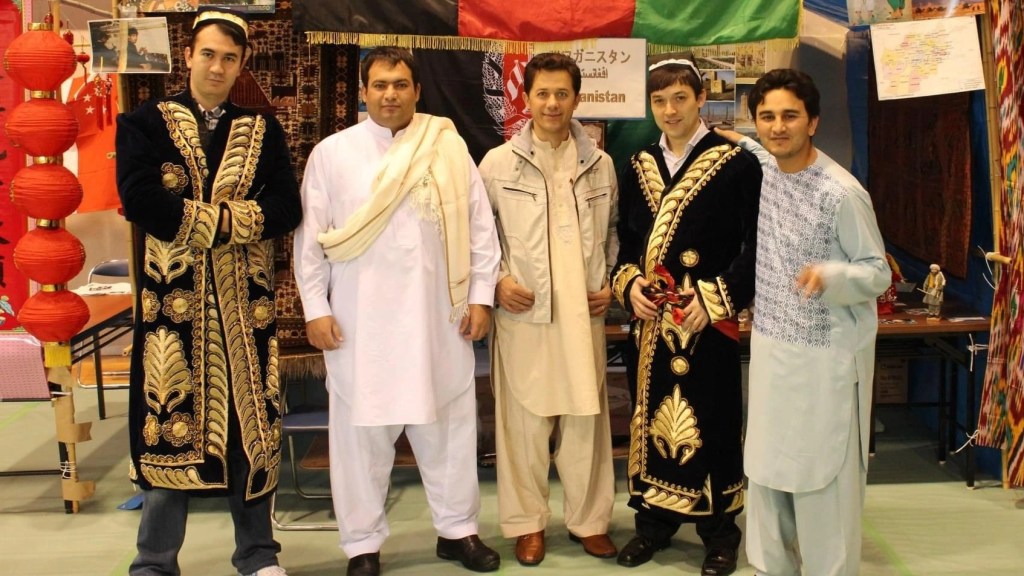
Photo caption: Hazrat can be seen in the middle of the team wearing traditional Afghan clothing.
 Hidden Hero