
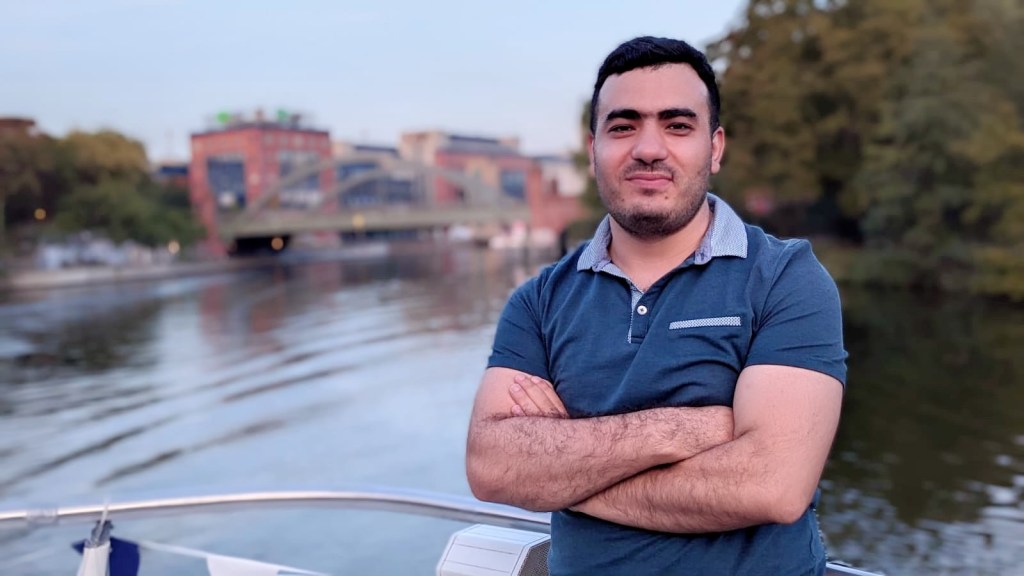
Wahid Azizi admires Germany for its significant contributions to the world and its status as one of the biggest economic powerhouses. However, he is aware that it can be challenging for newcomers to adjust to aspects of life in Germany, such as punctuality, which may not have been emphasized back in his home country of Afghanistan, and to learn a new language. Wahid arrived in Germany as a student in the middle of the COVID-19 pandemic in 2020. “As I expected, it was quiet, and the first few days passed quickly as I navigated the German bureaucracy, attended lectures, and explored a new culture, city, and its people, discovering a hidden passion inside me.”
Wahid has a Bachelor’s Degree in Political Science and International Relations as well as a Master’s Degree in Global Public Policy. He worked with various organizations, “primarily in the fields of anti-corruption and development,” he says. While he was working with Transparency International in Berlin, he engaged himself on climate financing, “our focus was to advocate for curbing corruption in climate projects.” Currently, Wahid is a Public Policy New Voices Europe fellow at the Salzburg Global Seminar. In the future, Wahid sees himself as an accomplished public policy expert, “I am interested in working in the climate sector, governance, and charitable causes,” he adds.
Wahid found it difficult to adjust to a new environment during the pandemic. He realized that the grey sky that hangs over Germany most of the time can affect human emotions, such as happiness. However, he found his way quickly and discovered a simple solution – walking. At his early days in Germany, he lived near one of the many lakes in Berlin and frequently took walks along the lake. Although Wahid has a few German friends he met while studying and working, he finds it hard to make new friends within German society. “Finding a German friend is like looking for a needle in a haystack. It often happens, particularly in Berlin, that non-German people first become friends with each other.” He indicates that the country offers great career opportunities for international students, “as it faces a shortage of skilled workers.” He adds, “Afghan youths are among the most talented people I know, and they should be treated as such.”
He recalls the previous regime in Afghanistan, ineffective governance, and the current grim situation, “with many losing hope in the future. The closing of schools for girls is a major issue at the moment, and many Afghans agree that it is further pushing the country into the abyss. It should not be like this.” Wahid compares the culture of Afghanistan with culture abroad and says: “Afghan society is a close-knit system where members rely on each other for survival and finances, and call on one another for help when needed. This has shaped unique relationships among members of Afghan society which become very handy when abroad.” Another cultural aspect of Afghanistan that Wahid reminds us of is the food, “which is not only delicious but is also used as an excuse for bonding and sometimes discussing intense socio-political topics.”
To his fellow Afghans, besides learning the German language, Wahid suggests: “to be mindful of respecting the local culture and offer the best of our own, as we are not just representing ourselves but the entire Afghan nation.” He believes there are many uncertainties and challenges when living away from home: “I can imagine many newcomers might give up on trying to make it in Germany. However, that should not be the mentality at the outset. Let’s remember that as long as there are problems in the world, there are solutions to them as well.”
 Hidden Hero