
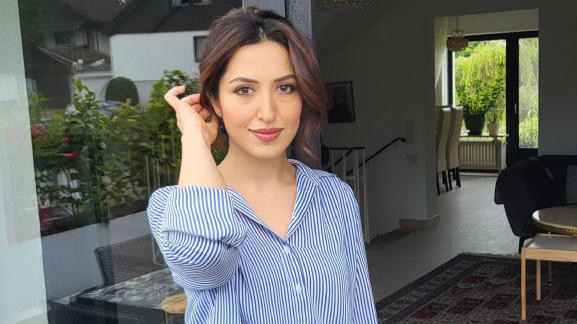
Roza M., age 35, was just six years old when she arrived in Germany. In Afghanistan, her father worked for the Prime Minister during President Dr. Najib’s regime, and her mother was a kindergarten teacher. Roza and her two brothers were born in Kabul. Roza remembers their first days in Germany as being filled with confusion, fear, and uncertainty. “We were afraid we wouldn’t be allowed to stay and that we would be deported. We lived for years without any prospects.” At that time, they didn’t have the opportunity to attend a German language course, and there was no support from other people who spoke their native language. The family arrived in Germany with only $50.
Compared to today the situation was very difficult for the first generation of Afghan refugees in Germany, according to Roza. “After several years of hard work, my parents received a residence permit and finally had the opportunity to attend an integration course,” she says. After 14 years, the family was granted German passports. “We celebrated. We were relieved and happy to be able to build a secure future in Germany.”
Education was a significant priority for Roza’s parents, since they grew up at a time when it was common for both girls and boys to attend school together in Afghanistan. Girls were encouraged to earn a vocational qualification before starting a family. Roza refers to that time as “the golden age of Afghanistan.” After graduation from high school, Roza studied Teacher Education at the University of Essen and later started working as a teacher in a school. She was following in her aunts’ footsteps, since they were also teachers.
During the waves of migration to Germany in 2015/2016, Roza came into close contact with refugees and engaged in projects that led her to social work. Today, she works with young people and adults at several schools, supporting and guiding them in their professional goals and development. “I love working with young people. You have the chance to accompany them in the most important phase of their life – the phase in which they are developing their own identity – to influence them positively and you also learn a lot yourself. They bring a breath of fresh air to the work and are very appreciative.” Roza’s experience over the decades shows how migration changes people in different ways when adapting to a new culture and environment.
Roza appreciates the evolution of Germany’s approach and policies for integrating refugees. She reflects on the past when there were no social counselling centers with interpreters, especially for languages like Dari, Farsi, or Pashto. “My parents did not have the opportunity to learn German, since one could only attend a German course with a residence permit. In addition, there were no online language courses or platforms like YouTube or TikTok available at the time.”
In Germany, Roza appreciates certain social behaviors. She says, “Germans are punctual, precise, and critical. I think that’s a good thing, as it shows why this system works properly and with accountability. But sometimes I find these characteristics exhausting, and that’s probably where my Afghan side comes out.”
She is familiar with Afghanistan through the news and through stories she hears from her parents and relatives. She knows that the country is rich in diverse ethnicities and cultural treasures, “but unfortunately, it has been exploited and let down repeatedly. Decades of war have caused many problems, leaving people traumatized and in constant survival mode,” she adds.
She continues to support her fellow Afghans in various ways. “I am part of a large Afghan community and still advocate for Afghan rights. For example, in 2013, my brother and I organized the first Dari language course with an Afghan teacher at the University of Essen. It was important to us that Afghan students learn to read and write in their mother tongue. I was also an active member of an organization called Daast for a long time. As volunteers, we organized demonstrations, planned charity events, and collected donations for a school project in Afghanistan.”
She is deeply concerned about the status of women and girls in Afghanistan. “They seem to have vanished from society as if they didn’t exist. A society dominated by only one gender cannot function properly. I see this as a significant problem for the social development of the country and a major threat to the mental health not only of girls and women but also of families. This can lead to depression, harm or suicide risk.”
Having two different identities, Afghan and German, can sometimes create an inner conflict for Roza. She believes that her generation, being both Afghan and German, struggles with not having a true sense of home. “They only know Afghanistan from their parents’ stories, and they grew up in Germany and don’t identify completely as German because they don’t fit the typical image of a German person.” Roza feels that Babak Ghassim’s poem “Hinter uns mein Land” accurately describes their situation – if they stay in Germany, they are like the beach, not quite sea, not quite land. “This is how most German-Afghans who have grown up in Germany feel – somehow both, but somehow not a whole.”
Roza describes life as a battle. She has learned that there is no straight path and that everyone faces challenges. “The trick is to overcome them without losing yourself, and, above all, never to lose faith in yourself and your dreams.” Understanding the situation of the people of Afghanistan and how they keep themselves alive despite poverty, war, and suffering gives Roza strength to look ahead positively and be thankful for what she has. “I am grateful for my current situation, having achieved personal development and professional success and having my family and friends around me.”
Dealing with social issues, especially about the personal, educational and professional growth of young Afghans in Germany, Roza has found that they face various challenges. She says, “We deal with other problems here in Germany. There is a rising one divorce rate among Afghans, Identitiy problems, existential fears, and the feeling of not being accepted in Germany despite all the efforts we have made to integrate. We feel uncertain about where we belong, and because of the current political situation, we are unsure about our future in coming years.”
Roza calls on world leaders to recognize the importance of education for girls in Afghanistan. “My message to the world is not to forget the girls and women in Afghanistan and to stand up for their right to education. Unfortunately, this issue has been completely neglected since the Taliban took control of Afghanistan. Education is a human right and human rights have no gender. In my opinion, the West, especially those who have been present in Afghanistan for the last 20 years, should take responsibility for the ongoing tragic situation in the country and take appropriate measures, such as not recognizing the Taliban regime. Unfortunately, the issue of women’s education in Afghanistan is no longer an issue in Germany.”
 Hidden Hero