
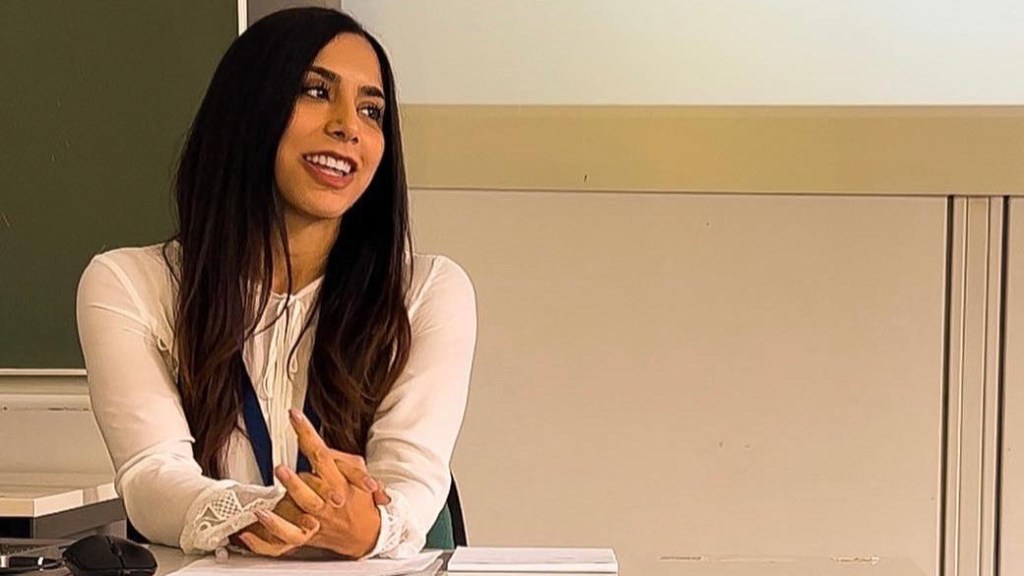
Her name means “Smile.” It was chosen by her aunt, who is a poet and also named all of her other four siblings. Muska Haqiqat and her twin sister were born in Germany. This Pashtun family is originally from the Kandahar province of Afghanistan. They fled the country when the Soviet Union invaded. “As members of the Mohammedzai tribe, my family was targeted by the communists and faced severe persecution.” In a secret operation, they fled Afghanistan with heavy hearts, leaving behind their home and everything they had known. “My parents still tell us stories about their life in Afghanistan and the family members who were persecuted and disappeared.”
Muska studied cultural anthropology and Islamic studies in Hamburg. She is now pursuing a PhD in Islamic Studies at the University of Cologne and has chosen the topic of “Pashtun Identity” for her dissertation. “I think that every human being, at some point in their life, goes through a phase where they experience a period of self-discovery. I wanted to find out whether Pashtunwali – the code of moral values and behaviors – is a common feature shared by the second generation as part of their identity.” She defines the second generation as migrants who were born and raised outside of their home country and face the challenge of reconciling their cultural identity with the society around them. “This group often experiences a feeling of being ‘in-between,’ not fully identifying with either Afghan or German culture, and feeling like outsiders in both. This can lead to feelings of isolation and a struggle to belong, as well as prejudice based on ethnicity or religion. I feel the same way.”
Aside from her studies, Muska is a counselor who provides advice to young migrants, with a specific focus on the occupational field. She is also involved in the “Education Without Books” project, established by Sadaf Zahedi. Reflecting on her involvement, she mentions, “I was invited to a panel discussion in Frankfurt, where I learned about this project that offers education to illiterate children in rural parts of Afghanistan. I consider it crucial for the children’s future and I am honored to be a part of it.” Muska has achieved a balance between her studies, work, and volunteer activities, which keep her engaged and continuously learning. She acknowledges, “certainly, it is not without its challenges and there are moments of stress. However, I feel fortunate and motivated by the opportunities I have. I am enthusiastic about the future and the potential for further academic and professional growth, while also having a positive impact on the lives of others.”
Muska appreciates the culture of bread in Germany. She says, “In Germany, a wide variety of bread is baked every day. I love bread and always miss German bread when I’m abroad.” However, in spite of her appreciation for German baking, she believes that migrants in this country still face significant obstacles in fully integrating into German society. “Discrimination, difficulties in the job market, and broader societal acceptance pose challenges for them. They often struggle to get their foreign qualifications and work experiences recognized, which can result in underemployment or being forced to take jobs that do not match their skills and education.”
Muska’s parents have instilled Afghan culture in her in various ways. They taught her to speak Pashto and introduced her to Attan, a traditional dance. Growing up in Germany, she still remembers being mocked as “Tora Bora” by a German acquaintance during the Taliban’s earlier period of rule (1996-2001) due to her ethnicity. “Through my initiatives, I explore such feelings and the cultural identity of Pashtun in Europe.” Unfortunately, she believes that since the Taliban recaptured Afghanistan in August 2021, the Afghan diaspora in general has been under even greater general suspicion.
When the return of the Taliban became definitive, Afghan communities abroad felt a sense of powerlessness mixed with pragmatism in the sense of trying to help people in Afghanistan in a practical way, a result of decades of wars and unrest in the country. “I was overwhelmed by what was happening in my home country. Security is a major issue, and the economic situation is dire at the moment. The international community is in a tricky position. They want to help the Afghan people with humanitarian aid, but there is a reluctance to formally recognize or support the Taliban. The rights of women and girls have been severely restricted since the Taliban took over. There are significant limitations on education, employment, and freedom of movement. It’s very difficult to predict what might happen next.”
For Afghans recently evacuated to Germany, Muska suggests the following: “Build a network of contacts in your field of interest. Attend events, join professional associations, and participate in community activities to integrate into German society. Join language exchange groups, sports clubs, or cultural associations to integrate into the community. Understand German workplace culture, learn about professional norms, communication styles, and expectations.”
During the COVID-19 pandemic, Muska learned and documented her mother’s cooking skills. “I had always intended to learn her culinary arts so that I could hand our cultural heritage down to our descendants. I haven’t learned all the dishes yet, so the project is still ongoing :-).” In her free time she travels and discovers new cultures. In her difficult moments, she thinks positive, stays organized and sets realistic goals.
She thinks that some aspects of Afghan identity should remain in Afghanistan: “The continuation of inter-ethnic conflicts within the Afghan diaspora, including in Germany, can have detrimental consequences. It can hinder the integration of Afghans into their new communities, create a climate of fear and distrust. Let us find unity and not carry out inter-ethnic conflicts in Germany. Instead let us highlight and celebrate the rich cultural heritage that unites Afghans, fostering a sense of shared identity and pride.”
 Hidden Hero