
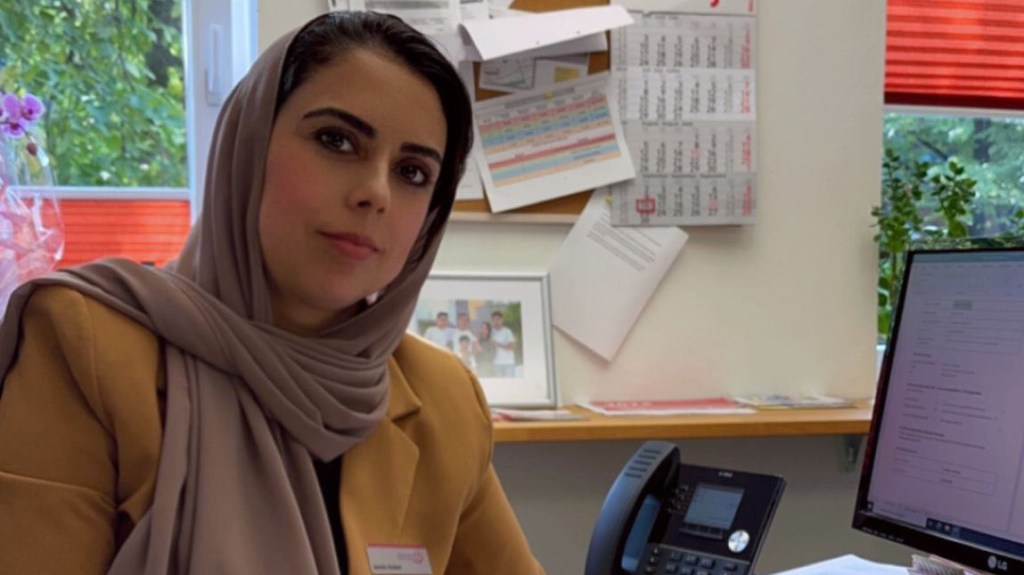
Sonita Haidari, 42, spent her childhood going from one country to another in pursuit of her final destination – Germany. She was only six months old when she left Afghanistan with her family. Their first stop was Iran, where they lived for over 12 years. Then, they moved to Moscow, the capital of Russia, and stayed there for about eight months. “We faced many problems in Moscow, including not knowing the language, being unfamiliar with the way of life, feeling like strangers, feeling lonely, and lacking official documents and money.” Due to these difficulties, the family left Russia and moved to Ukraine and then to the Czech Republic before reaching their ultimate destination. Upon arriving in Germany, they found comfort after years of struggling in other countries. “Although the language remained a significant challenge, the supportive laws and financial aid from the government facilitated our early days in Germany.”
Having lived in Germany for 37 years, the mother of three sons still recalls the ridicule she faced from her classmates due to her poor language skills. Reflecting on her experience, Sonita says, “Because of my language problem, other schoolmates laughed at me. Then, I put more effort into learning the language and building social connections.” She became actively involved in school events and programs for students. After graduating from school, Sonita got married. “Our marriage was traditional and full of love and happiness,” she says. By that time she had also pursued an apprenticeship in hairdressing.
When Sonita welcomed her first child, she decided to stay at home to take care of her children and her family. After some time, she began studying social affairs and psychology in order to support projects that assist refugees and immigrants in Germany. “I wanted to help refugees avoid the same struggles I faced as a refugee myself. That’s why I started working as a consultant providing advice and support to refugees in Germany from various countries.” She is currently working as an immigration consultant and has provided support to over 8,000 refugees from different nationalities over the course of her career in the city of Elmshorn. She can now speak six languages.
According to Sonita, most of the refugees who arrived in Germany in 2015 were primarily economic migrants with limited education and skills. By contrast, most of the refugees who arrived after the Taliban took over in Afghanistan were better educated and had held professions in their home country. “However, for refugees and immigrants, regardless of their background, I want to convey the message that they can regain their strength and stability by working hard after overcoming challenges. It’s important for them to take advantage of the opportunities provided by the state and contribute positively to both their own lives and society as a whole.”
Sonita respects Afghan culture and continues to practice it. She says, “As an Afghan woman who was raised in a European country, I keep adhering to Afghan culture and traditions. I want to be a role model for other Afghan women and girls and show that despite all of our cultural and social restrictions and challenges, we are still strong enough to attain our dreams if we work hard. I am grateful to Allah that most of these women have taken advantage of the opportunities available to them and have built successful careers and personal lives.”
“Afghan girls and women are struggling in Afghanistan; the world must act and stand against the violence that is ongoing in the country. We must not forget the millions of vulnerable people who are living in uncertainty and in a dark situation under the Taliban regime.”
 Hidden Hero