
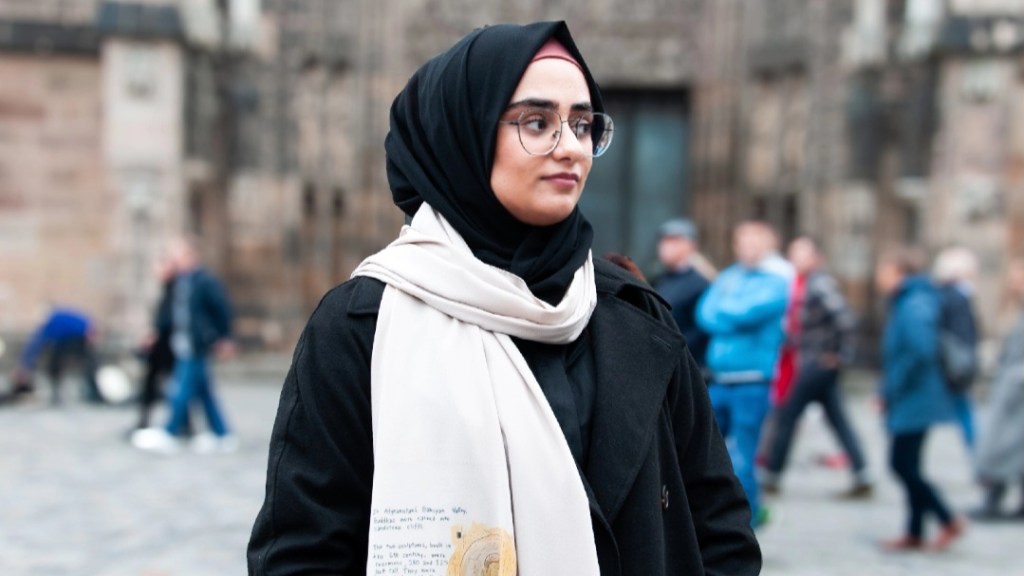
Nazanin, 28, has three brothers and one sister. She lost her oldest brother two months before the collapse of Afghanistan to the Taliban. “I now live with my parents and siblings in Germany.” Nazanin is a lawyer who studied Sharia and Law Faculty, department of Law & Islamic Jurisprudence at Salam University. After her graduation, she started the advocates stage at the Afghanistan Independent Bar Association (AIBA) and continued her training as a lawyer. Simultaneously, Nazanin was admitted to the Legislative Stage Program at the Ministry of Justice. After completing both programs, she started working as a defense attorney. “I worked in private practice for a while, then I worked with several law firms.” She also completed an internship in the Arbitration and Mediation Stage at the Afghanistan Commercial Dispute Resolution Center Before the Taliban took control of Afghanistan, Nazanin worked as a defense lawyer in the legal clinic of Kardan University as part of one of USAID funded project, which was implemented by Afghanistan Justice Organization.
Nazanin faced challenges working in judicial institutions in Afghanistan due to her young age and lack of experience. “However, my passion for my profession grew every day.” Throughout her career, she handled numerous criminal and family law cases, including divorce, separation, and domestic violence. “Witnessing the oppression and victimization of Afghan women up close further fueled my dedication to my work. I also realized that the lack of knowledge of the law among people led to significant losses due to ignorance.”
When the Taliban came, Nazanin found herself in a stressful situation trying to protect herself and her family. “I didn’t even have a passport because I never anticipated the new situation in Afghanistan.” After facing various obstacles, she managed to obtain a passport from a city other than the capital. Nazanin applied for protection in several countries and Germany promised to approve her request. Although she was legally responsible for her family, she alone was granted approval by Germany. Refusing to leave her family behind in a dire situation, she took them with her and went to Pakistan. “We spent over nine months in a long and stressful wait before coming to Germany.” During her stay in Pakistan, Nazanin voluntarily supported organizations such as the Max Planck Institute and Kabul Luftbrücke to help eligible Afghans with the evacuation process, since she knew the Urdu language. “The employees of these two institutions worked voluntarily to assist Afghans, including myself, under extremely challenging conditions. I am forever grateful for their efforts.”
It was difficult to accept the feeling that she had to start everything from scratch, but Nazanin tried to convince herself to accept the situation by making appropriate plans and thinking less about the past. “I started learning the German language when I was in Pakistan, and now I am in the C1 German language class.” Compared to her first year after migration, she is more aware and calmer, but restless at the same time. “I am trying to finish the expected language level as soon as possible and begin a new life here. I’m trying to stop thinking about our wounded past, keep my motivation strong and my goals high, and not limit life to eating and sleeping, but make the most of the opportunities offered here.”
When Nazanin arrived in Germany, she made an effort to connect with Afghan communities in her city. “I took part in a demonstration condemning the Taliban and their oppressive decrees,” she says. There, she met other Afghans, many of whom were also new to Germany but were already involved in social activism. “I also found out that the Damigra organization was organizing a city trip for around 100 Afghan women.” As there was a need for volunteers, Nazanin began volunteering with the organization because she is fluent in both English and her native language, Dari. She continues being a volunteer with the organization. “My role involves planning various activities for immigrant women, particularly newly arrived housewives who are unfamiliar with German society. We organize language lessons and welcome ideas and activities that we believe would be interesting and beneficial for women.” She was awarded the Elisabeth Selbert Initiative Scholarship by ifa. The six-month program helped her complete an internship with the German Human Rights Institute and collaborate with the team supporting the German Federal Admission Program for Afghanistan. Recently, she received a fellowship from the Every Woman Treaty organization, allowing her to continue learning about various human rights topics.
The thing that attracts Nazanin the most about Germany is its flexibility in terms of work and educational opportunities. “You can work two or three days a week and spend the rest of the week studying. It is useful to explore a wide field of study in order to grow as a person, but of course that means you have to exert a lot of effort.”One of the unpleasant things she still experiences in Germany is racism and the fact that people’s migrant background is always noticed and mentioned. “This sometimes feels like it keeps me from integrating more effectively into German society. Of course, I love my cultural and ethnic origin and my nationality, and they are dear to me. But repeatedly hearing that you are an immigrant and a foreigner transmits negative energy to a person, even though everyone knows that no one emigrates unless they are forced to.”
According to Nazanin, the extreme emphasis on crimes committed by immigrants has had a significant impact on the situation and people’s views of immigrants. “Every society, including German society, has criminals. But when an immigrant does something wrong, it is in the headlines for weeks, and this is very annoying. All in all, crime is a personal act, and each criminal actor has his reasons and motives for the crime; it has nothing to do with a person’s nationality, so it should not be generalized to all. We have been victims of political games long enough, and sometimes, we do not feel safe and stable here either.”
Going back to her memories from childhood, Nazanin heard many stories from family elders about the first round of Taliban rule In the 1990s. “I could not imagine that this history could be repeated in our generation in the 21st century. The situation in Afghanistan is deplorable. It is a nation that is 99% Muslim, yet Afghans are being treated as if they are just learning about Islam. We have fallen into the hands of people who have a different interpretation of religion. I remember when I was a student that one of my professors always said to pray ‘may God grant us a correct understanding of religion.’ Surely this is a blessing that has not been granted to a group called the Taliban. They have used religion as a tool for their political games, and the victims of these games are the Afghan people, especially Afghan women.”
Nazanin says: “It is difficult to predict the future of Afghanistan. First, if the world continues to support the Taliban financially and is indifferent to their actions, it will be very difficult to change the situation. Second, it is a big mistake only to look to other countries to do something for us. We will not find comfort until we do not find unity. We make ourselves the toys of politicians. We have not developed unity and mutual acceptance among ourselves, and each separate group wants power for itself. The new generation has always been a victim of the wrong decisions of the older politicians who neither know politics nor have enough knowledge to run the country. In my view there should be an alternative to the Talib from a new and more aware generation, and not from politicians who have already failed many times in the field of politics.”
“What I want to say to the world is that you have fought and tried hard to gain power. Now, let’s strive for world peace. As a woman, my message and my efforts have always been to make the world a safe place for women. I hope for a world full of peace and a peaceful, prosperous Afghanistan free from discrimination against women.”
 Hidden Hero