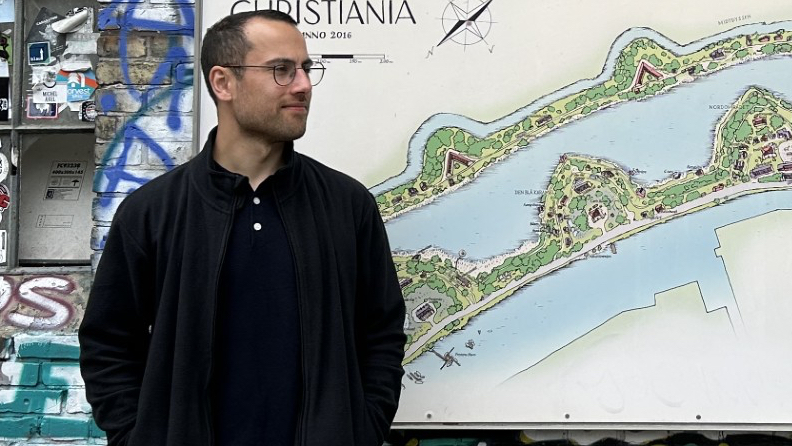
Years ago, when Hoschang Noori was just two years old, his relatives fled Afghanistan through Moscow, followed by his mother with Hoschang and his sister. “You can imagine how dangerous such a journey was, especially for a woman alone with two small children and a male relative.” Two years after they arrived in Germany, Hoschang’s father joined them. “We were very young and had no memory of our father; we first met him at midnight in the living room, in the presence of my mother and two uncles.” Now 29, Hoschang lives in Kassel and has three siblings. His father was an art lecturer at Kabul University, while his mother was a teacher at a local school. In Germany, Hoschang’s parents started working as cleaners to integrate the family in German society and eventually get German citizenship securing their children future as they grew up in a small town in the Sauerland region.
Hoschang is a research associate in the field of measurement and control engineering at the University of Kassel. His research focuses on photonics and quantum technologies. Initially, he pursued a bachelor’s degree in mechanical engineering, which he found took much longer than expected, “I had younger siblings and cousins for which I took the responsibility upon myself to serve as a guide,” he says. Later, Hoschang shifted his focus to a more information technology-oriented path for his master’s degree, a decision he attributes to his bachelor thesis supervisor . During this time, he wrote a project paper on informed machine learning under the supervision of a research associate who later encouraged him to work as a student assistant. Hoschang accepted this opportunity and went on to write his master’s thesis on the nonlinear dynamics of recurrent neural networks, positioning himself at the intersection of AI and physics. Ultimately, the university offered him a position to continue as a research associate. “I accepted because I found the diverse daily work of research, management, and teaching very appealing. My daily tasks specifically involve conducting experiments, programming image processing and computer graphics algorithms, supervising student projects, conducting classes, and reading and writing scientific articles.”
For a long time Hoschang thought that he was being treated unfairly because of his background, “then I realized that life is simply unfair, also thanks to my martial arts trainer” he says. According to Hoschang the West offers a unique opportunity for social mobility, even for people who are essentially outsiders. “Such opportunities don’t exist anywhere else in the world. To put it bluntly: An Afghan in Iran will get nowhere. A Syrian will hardly achieve anything in Egypt. And a Bangladeshi or a Pakistani in the Gulf states is doomed to a life of poverty and slavery. That’s something to think about.” He agrees that social mobility is challenging but emphasizes the possibilities. “The West is definitely open to criticism, but it is also capable of self-reflection. I know many who say that the West sometimes handles its values hypocritically. I can’t argue against that – they are right But at least it is possible to remind the West to adhere to those values. That’s not possible in China or Russia.”
Hoschang enjoys green tea and likes Afghan food. He also loves listening to Rubab and Tabla music concerts. “A friend of mine is an excellent Rubab player and organizes such events. He even lent me his expensive Rubab once to help me learn how to play. I can’t say much about Afghan social norms and values. Everything I value has been passed down from my parents,” he says about his origins.
When it comes to friendships, Hoschang does not take ethnicity or religion into account; other factors play a larger role. “On reflection, my closest circle mainly consists of people with immigrant backgrounds, like late repatriates or East Germans. However, most of my friends are indeed German. I go my own way and only very rarely seem to meet Afghans on it.”
In the future, Hoschang would like to participate large research and development projects. He also likes trying many new things because “you learn a lot about yourself in the process. During my bachelor’s, I practiced martial arts a lot. Last winter, I took a salsa course. I also once sang in a choir.”
 Hidden Hero