
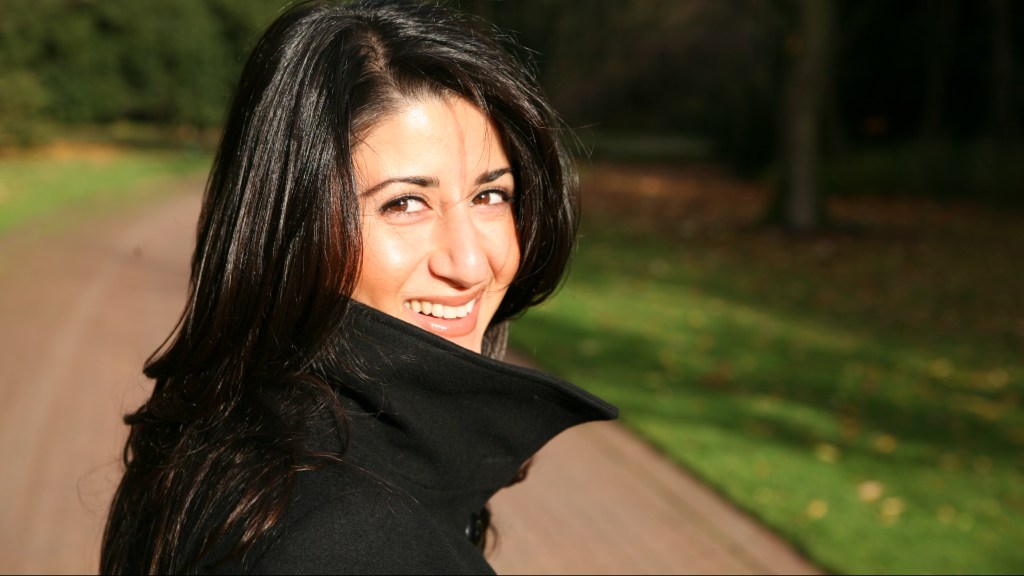
Homeira met her German partner in a circle of friends in Passau. After a couple of months, they fell in love. “It was serendipity, not a plan. Love can be that easy.” The 47-year old woman has one child and lives in Passau. She came to Germany when she was only 3. “We immigrated with my mother and two siblings. We took the route from Kabul to Peshawar, Pakistan, traveling with smugglers by truck and by donkey.” They stayed in Peshawar for a time and later moved to Islamabad. Short after they flew from there to Frankfurt. “We were housed in a refugee camp in Bad Schwalbach. I remember it as a warm and welcoming place. I loved the flavors of the new foods.” It was 1980, and Homeira’s family was among the first refugees to come from Afghanistan. Soon they moved to Münster, where Homeira’s grandparents and her uncle were already waiting for them.
Homeira stayed in Münster for two more years and then the family moved to the United States for a short time. “We had some family members living there. We stayed for two years and moved back to Münster because my father didn’t feel very comfortable in the US. His German was perfect, but he struggled with English and the lifestyle in the US.” Homeira’s father studied the German language when he was a student in Amani high school in Kabul.
For Homeira, the city of Münster offered a lot of opportunities, both personal and professional. “I miss the city a lot. I loved to go everywhere by bike. The quality of life in Münster is very high. The cultural offerings such as the beautiful public library and museums, the cafés, the Aasee, which has won multiple awards, the promenade, and the old architecture always give me a cozy feeling of being home whenever I am there.” Homeira pursued her education in Political Science, English Studies, and Philosophy at the University of Regensburg and at the University of Münster.
From the time she was a teenager, Homeira frequently engaged in political discussions with her father. “I would ask him questions about Afghanistan and the global situation, sometimes annoying him with my constant inquiries. My goal was to understand the roots of such conflicts and explore possible solutions,” she recalls. This passion for inquiry ultimately led Homeira to pursue a career in journalism. After completing her studies, she worked with several organizations, contributing to their media and public relations departments. Throughout her career, she has held various roles, including freelance journalist, project manager, press spokesperson, and board member. Currently she is working in a child and youth welfare facility as a quality and Project manager.
In 2012, Homeira initiated the Afghanistan Online Dossier for the bpb (Bundeszentrale für politische Bildung). “It has always been clear that Afghan voices are not heard enough, which means that Afghans‘ perspective on their own country is underrepresented. So, I aimed to present an alternative viewpoint on a platform that is well-recognized and widely seen.” She also served on the board of the Civil Society Forum Afghanistan in Bonn, where she facilitated meetings between women and key political figures. “These meetings were held alongside a conference of foreign ministers. The goal was to provide Afghan civil society with a voice and to showcase the valuable work of Afghan women. We met with Hillary Clinton, Ban Ki-moon, and many other political stakeholders. It was crucial for Afghan women to be heard and seen, especially at that time, as it was important to secure further support and acknowledge their initiatives.”
Homeira directed the Afghanistan Film Festival at the Cologne Film House for over two years. “The festival helped many people understand more about the situation in Afghanistan.”
After separating from her first husband, Homeira began creating podcasts. “I felt it was the right moment. I felt empowered myself. I wanted to surround myself with women and peers who have faced their own challenges and stand together in fighting against patriarchy and misogyny.” Her podcasts feature inspiring stories of women striving to create a better world and promote gender equality. Homeira aims to provide a platform where women can voice their experiences, support one another across various fields, and raise awareness about issues that affect their gender.
Homeira published her master thesis: “Afghanistan – a Failed State?” and worked as a radio author at Deutsche Welle.
Homeira feels well integrated into German culture. She notes, “Of course, there are some customs that differ from the way I grew up, but I have adjusted to them. For instance, hospitality is expressed differently here. However, I appreciate how punctual, honest, and disciplined Germans are. Most of Afghans tend to communicate in a very indirect way, while Germans are very direct. This directness can be irritating at first, but you get used to it over time and come to understand that it’s not impolite—it’s just their nature.”
She encourages her Afghan peers to connect with Germans: “Try to make German friends. They can be as loyal as your Afghan or other Muslim friends. Invite them over for an Afghan dish and have engaging conversations. Share your experiences with them. Communication is the best way to foster understanding. While it may be easier to stay within your own circle and comfort zone, it won’t help you integrate effectively.”
Homeira is deeply concerned about the current situation for women in Afghanistan. She states: “All the things taking place are acts of barbarism—unseen and unheard by the international community. The Taliban seeks to erase women from every aspect of society and keep them in cages like wild animals. My heart aches, especially knowing that things have not changed despite the efforts of people around the world. How many more generations will have to suffer from the Taliban’s pathological hatred of women? Their understanding of Islam is completely perverted and only serves to satisfy their hunger for power over women. Despite the hopelessness of the current situation, please do not stop speaking out against the oppression of Afghan women.”
“Educate your children, both boys and girls, and give them all the love you can. This helps them become better, more stable human beings with less pathological behavior. Respect for the opposite gender is the foundation of overall harmony. The Taliban’s laws are among the most severe atrocities against women, but many injustices also occur behind closed doors in numerous marriages. Men often perceive women as their servants, and women are sometimes conditioned to accept this role and remain silent in the face of various forms of domestic violence. We need to find a way to move beyond patriarchy. The only viable path forward is to acknowledge each other’s suffering, both physical and mental, understand it fully, and support one another, rather than minimizing what people endure.”
 Hidden Hero