
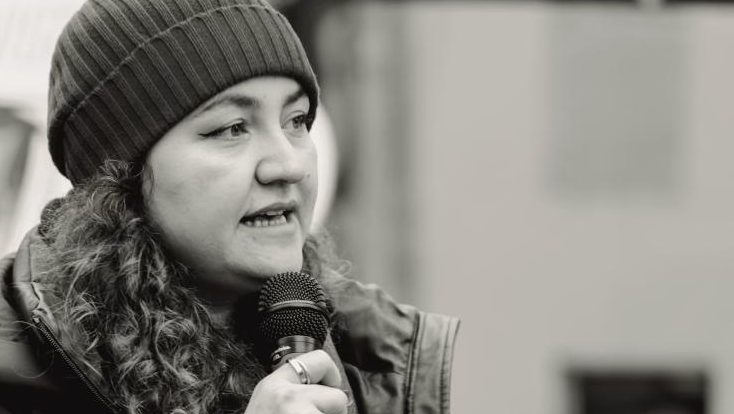
Farangis Sawgand’s journey began in Afghanistan, where she grew up witnessing the challenges that women face in a society marked by conflict and inequality. “These experiences deeply shaped my passion for social justice and ultimately led me to dedicate my life to advocating for the rights of women and marginalized communities.” Farangis is a poet, writer, politician, and women’s rights activist who has served as a member of Youth Parliament and on the Balkh Provincial Council in Afghanistan. Driven by her passion, she earned a Bachelor’s degree in Law and Political Science. Her academic pursuits are closely linked to her activism and she believes that having a strong understanding of the legal framework is essential for effectively defending human rights.
Throughout her career, Farangis has been actively involved in various media activities, including print, visual, and broadcast journalism in Afghanistan. She worked as a journalist with the German Armed Forces in northern Afghanistan, where she gained valuable insights into global political, security, and social issues. Her articles and essays were published in several newspapers, magazines, and books, often focusing on themes such as gender equality, social justice, and cultural identity. “Writing has always been a powerful tool for me to express the complexity of the human experience and challenge the status quo.”
In Afghanistan she founded two cultural and women’s rights organisations, Gawharshad Begum Cultural House in Faryab and the Khorshid Cultural House in Balkh. “These organizations served as platforms to promote women’s empowerment, cultural heritage and social dialogue. In my role as a leader of these initiatives, I organized events, workshops and campaigns that addressed important issues such as education, domestic violence and legal rights. My leadership role in these organizations not only provided support to countless women, but also started a chain reaction that inspired others to take up the cause.”
Her engagement as member of the Balkh Provincial Council expanded her advocacy efforts. “I worked tirelessly to provide legal support to women who were detained without due process to ensure that their cases were heard and justice was done.” In parallel, her role as Member of the Parliament allowed her to influence policy decisions and call for reforms that would benefit women and other vulnerable groups.
Her involvement in media and cultural activities further solidified her commitment to the literacy arts and freedom of expression. She led the Gawharshad Begum monthly magazine, which she calls an influential voice in the literary and feminist movements in Afghanistan. She was also member in the Free Writers Association of Balkh-Afghanistan and the Afghanistan Pen Association.
In 2015, while Farangis was on her way to a conference to deliver a speech, her car was attacked by the Taliban. Fortunately, she survived the armed assault. After the attack, she received several threatening phone calls, making it impossible for her to remain in Afghanistan. Subsequently, she organized a press conference attended by various international organizations. Farangis was advised to move to the United States or Germany for her protection. Having previously worked as a journalist with the German Bundeswehr in Mazar-e-Sharif, she decided to relocate to Germany after being granted a visa.
In Kiel, Germany, Farangis is jury member at the Literature House Schleswig-Holstein and also involved in the Young Literature Prize Contest. She continues her advocacy work as co-founder, with other women activists, of the Afghanischer Stammtisch SH organization, which focuses on defending the rights of women in Afghanistan. “This organization engages in advocacy work, raises awareness of the ongoing challenges facing Afghan women, and provides educational resources to empower them.”
Farangis‘s work in Germany is driven by a deep sense of responsibility for those who remain in her home country, “I am determined to use my voice and resources to effect meaningful change,” she says. That is why she regularly organizes demonstrations and rallies in Germany. “It is important for me to draw attention to injustices, especially the situation of women in Afghanistan living under Taliban rule. The stories of women and girls who are massively restricted in their everyday lives motivate me to stay visible and share their concerns on social media.”
“Despite the harrowing reality facing women in Afghanistan under Taliban rule, hope remains. Hope for a future in which girls can go back to school, in which women can realize their dreams and make their own decisions about their lives. Hope for a society in which justice, education and freedom are not privileges, but basic rights.”
According to Farangis, resistance against oppression lives on in the voices and courage of countless women both in Afghanistan and in the diaspora. “History has shown that no regime lasts forever, that the longing for freedom is stronger than any tyranny. Every effort, every voice and every show of solidarity helps to continue the fight for the rights of Afghan women. I wish for a future where women all over the world, especially in Afghanistan, can live in freedom – a future where their strength, knowledge and dreams are the foundation of a just and peaceful country.”
 Hidden Hero