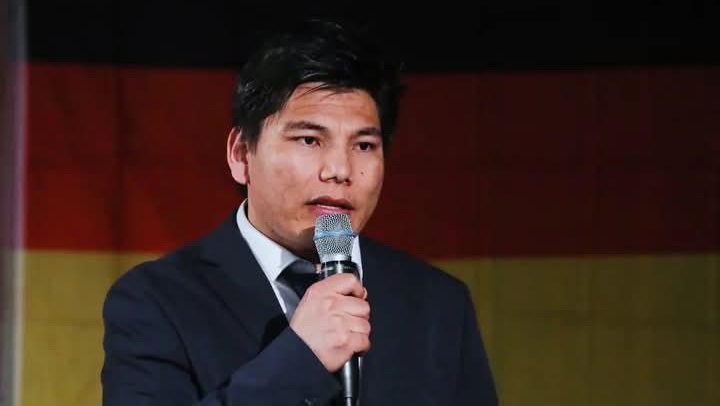
Saadat Amiri, 27, comes from a large, close-knit family with three sisters and four brothers. As the eldest sibling, he has had many responsibilities from a young age. His family are farmers living in Afghanistan, and Saadat spent his childhood and teenage years moving between Afghanistan, Iran, and Pakistan. “I was only able to complete primary school formally,” he explains. “Due to my family’s circumstances and the challenges of living in remote areas, I couldn’t continue my education.” Instead, Saadat dedicated much of his time to working and supporting his family. Despite these obstacles, he continued to pursue learning informally—with the help of relatives and friends, and through self-study. “In Iran, I worked primarily in construction, gaining hands-on experience in wall building, tiling, concrete work, stone cutting, and other related tasks.”
In 2016, Saadat arrived in Germany as an asylum seeker. “The difficult conditions in Afghanistan forced many people like me to leave behind our homes, friends, and loved ones,” he says. “It was not an easy decision, but it was the only way to move forward with life.” The first few months in Germany were filled with challenges. The language, culture, laws—everything was new and unfamiliar. “Yet amid all the difficulties, the sense of safety and freedom was invaluable. What I cherished most was the personal freedom, the freedom of expression, and the opportunity to grow.”
The asylum process in Germany during those years was marked by long periods of waiting and constant uncertainty. Each stage brought its own kind of stress, Saadat recalls. “Looking back, I see that the process has only become longer and more difficult. Policies today are even more restrictive and emotionally exhausting, which makes me deeply concerned for those whose cases are still unresolved.”
Saadat learned German through a mix of formal courses, informal lessons, and—most effectively—daily interactions. “Very soon, I began engaging in social, civic, and political activities,” he says. He had two main goals: to understand his rights and responsibilities in a developed society, and to contribute meaningfully to his community rather than be a burden. “This path gave me the motivation to study harder and progress faster.”
Saadat initially began vocational training as a dental assistant, driven by a desire to help others through a career in healthcare. “My plan was to eventually work with Doctors Without Borders,” he explains. The relatively regular working hours in dentistry also gave him the flexibility to continue his education. After completing his training and working in the field for two and a half years, Saadat decided to change direction. “While working, I attended evening school, and over time, my focus shifted. I became more passionate about pursuing higher education in social work and sociology.”
With that goal in mind, Saadat later took on the role of a teaching assistant. “This job gives my life purpose and meaning,” he says. “It also provides a strong foundation for my future studies in social work and sociology. Working with people of different nationalities, languages, and age groups exposes me to a wide range of perspectives and experiences, which I find deeply enriching.” Today, Saadat works as a teaching assistant at a local school in his city. At the same time, he is pursuing his Abitur—Germany’s university entrance qualification—attending classes to complete his high school education.
Saadat is actively involved in several social and cultural organizations, with a strong focus on organizing community programs, fostering connections between different groups, and advocating for the rights of migrants. He co-founded Ein Herz für Afghanistan (“A Heart for Afghanistan”), an initiative that supports education, clean water access, and the construction and repair of schools and roads in Afghanistan. As a board member of Heimaten Jugend e.V., Saadat works to raise awareness and advocate for the rights of young migrants—particularly in political, social, employment, and integration matters. He has also been engaged with Bellevue di Monaco and other cultural organizations, contributing to a variety of social and community-based projects.
In addition to his local work, Saadat continues to support charitable and educational initiatives in Afghanistan. He is also politically active in Germany, organizing demonstrations, protest rallies, seminars, and cultural events. “I have always been committed to the freedom and prosperity of Afghanistan,” he says.
Saadat deeply misses his family, who remain in Afghanistan, but visiting them is currently impossible. “Due to restrictions related to my residence status and the dire security situation in Afghanistan, traveling there is not an option right now,” he explains. Despite this, Saadat has found a sense of belonging in Germany among diverse communities. “At times, the sense of distance and cultural difference can feel overwhelming,” he admits. “But what matters most to me is that there are opportunities for growth, that I have friends, and that I can both give and receive support. Geography itself—whether Germany, Afghanistan, or anywhere else—is secondary. What truly matters is the presence of humane conditions for life.” Still, the suffering and hardships faced by the Afghan people weigh heavily on Saadat. He constantly reflects on what more he can do to help improve the situation in his homeland.
Saadat’s life has been a journey marked by struggle, perseverance, and steady progress. “I’ve become calmer and more hopeful,” he reflects. “Professionally, I’m on a new path. A lot has changed, but I still carry many plans and dreams for the future.” Despite having lived in Germany for nearly ten years, Saadat still only holds temporary residency status—a situation that, he says, continues to place limitations on his opportunities and long-term stability.
To his peers, Saadat offers thoughtful advice: “Even if your asylum claim is rejected, it’s not the end of the road. Life does not stop there. Use your time wisely—learn something new, pursue education, and develop practical skills. This not only strengthens your personal future but also improves your chances of being able to stay.” He also emphasizes the importance of emotional resilience: “Learn to manage your worries and stress. Let them be temporary—don’t allow them to take control of your life.”
“Let us recognize our shared humanity beyond borders. We all seek the same things—safety, peace, and a better life. If we approach one another with empathy and respect, the world will undoubtedly become a more beautiful place.”
“To the countries that have welcomed migrants, I say: please don’t see them only as a ‘problem.’ Migrants carry enormous capacity and potential. With thoughtful and inclusive integration, they can help build a better, more equitable future for everyone.”
 Hidden Hero