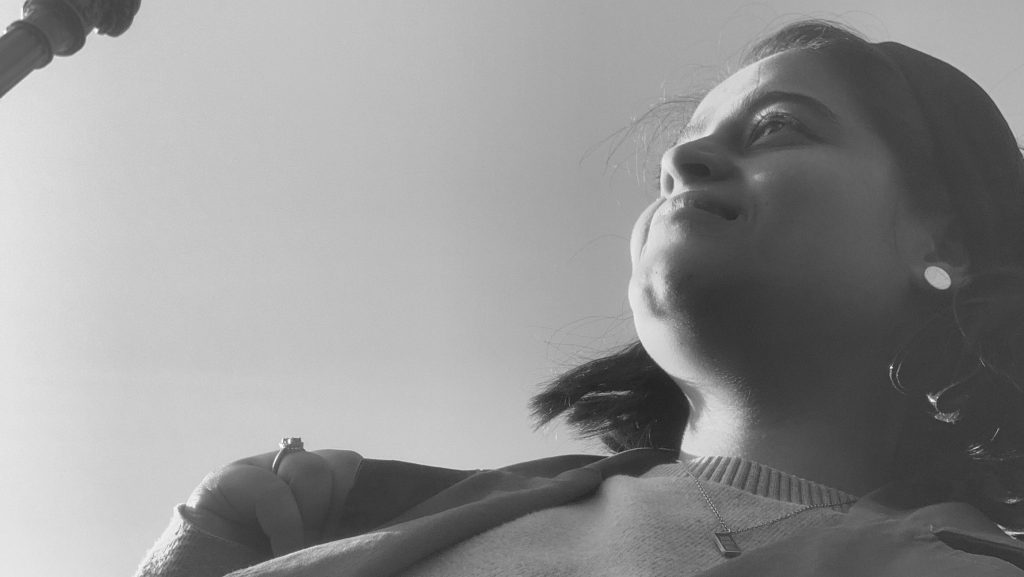
Bahar Arfan was born in 2000 in Iran, far from her family’s homeland. “During those years, my parents were forced to flee Afghanistan under the dark shadow of the Taliban regime, seeking refuge in Iran in the hope of finding safety and a better future.”
After the fall of the Taliban, her family decided to return home. For them, the return was a kind of rebirth; for Bahar, it marked the beginning of discovering a land that would shape her through both its beauty and its challenges. “I grew up there, started school, and from an early age realized that being a woman—a girl—in Afghanistan was a winding and difficult path.”
At that time in Afghanistan, gaining admission to university was difficult for many young people—especially for girls like Bahar. Today, under the Taliban, girls are not even allowed to pursue an education. “The lack of facilities, insecurity, social pressures, and cultural restrictions were the main obstacles.” Yet Bahar fought against them. To defend her right to learn and achieve her dream, she had to struggle not only with the society around her but also within her own family.
Bahar passed the entrance exam and was admitted to the Faculty of Fine Arts at Kabul University. “Education was not just a choice for me—it was a passion rooted in my heart, something I fought for.” Her dream of becoming a military pilot could not come true because of the restrictions placed on women in Afghanistan. But after being accepted to Kabul university and discovering the Studio of Contemporary Arts at Faculty of Fine Arts, she found a new path. She realized that art was “a language of equality, justice, peace, and resistance—a language that transcends the boundaries created by politicians and connects people. Art is my way of standing against inequality and violence, and my voice to reflect the realities of my society.”
Her days were spent attending university classes and teaching at a private school, while her nights were filled with dreams of learning and discovery. But fate took a different turn when Bahar was in her sixth semester of study—the Taliban seized power once again. “In those days, fear and despair settled over the city like a heavy dust.” She had never imagined that the Taliban would return, or that she would be forced to relive the same bitter experiences her mother had endured. “My whole body still trembles when I remember that day.”
Bahar was forced to leave the land where she had grown up and worked for years. “That decision was one of the most difficult moments of my life—for me and for my family. I left my homeland suddenly, and out of necessity.”
Bahar migrated to Germany in 2022 and began studying Art and Design at HfG Offenbach University, supported by a scholarship. “I started university three months after arriving, even though I didn’t know the German language. I was full of words, yet unable to speak them. During my first two semesters, I struggled with mental and emotional challenges—feelings of inferiority and loneliness. But gradually, I became familiar with the language and made new friends. I must say that my professors and all my colleagues at HfG helped me greatly along this journey, and I am deeply grateful to them.”
From her first connection with the Studio of Contemporary Arts in 2019 at Kabul University to her life now in Germany, Bahar has remained an active member of the the Center for Contemporary Arts Afghanistan in exile e.v. “My first encounter with the Center in Kabul changed my life and artistic journey. There, I learned that art is not only about beauty and color—it can also be a language of justice and equality, a tool to stand against oppression and violence. From that day on, the canvas became more than a space for creation; it became a stronghold of resistance.”
Based in Frankfurt, the Center for Contemporary Arts Afghanistan in exile e.v. is an open platform for the cultural and artistic exchange and collaboration, welcoming artists from around the world to embrace opportunities for education, joint projects, and creative partnerships. The Center also stands for resistance against forced migration, advocating for artistic freedom and cultural dialogue.
Bahar’s art primarily focuses on themes of war and gender inequality in Afghanistan. In collaboration with the Center for contemporary Arts Afghanistan in Exile e.v, she has exhibited her work in several international exhibitions. One of her notable pieces, From Guantanamo Prison Until August 15, was presented as a video performance. “In this project, the color orange symbolizes the condemnation and oppression of the Afghan people—especially women—under the Taliban regime, who today remain victims of violence perpetrated for the purpose of advancing a political agenda.”
For Bahar, settling into her new home was not easy. “Everything was new and unfamiliar. But as I learned the language and became acquainted with the culture, I began to feel more at ease. I realized that Germany is a place full of opportunities for growth—a place where you can rebuild your life and your dreams.” She believes it is never too late to start over. “I was in my third year of university when the Taliban returned to power, and I had to restart my studies in Germany, in a new environment and without knowing the language. But now I believe that if a person has a goal and motivation, they can overcome any obstacle and achieve their dreams. The path may be challenging, but nothing is impossible.”
Bahar recognizes that her journey is far from over. “Every time I think about the more than 20 million Afghan women who are currently deprived of their most basic rights, my motivation to work harder and continue on my path doubles.”
As an Afghan woman artist, Bahar offers this message to the world:
“The world should know that we, the migrants, were forced to leave our homeland. Those who take a stand against migrants are, in fact, accusing the victims—not the real perpetrators of these forced migrations. The world must understand that millions of people have suffered due to circumstances they did not choose.”
 Hidden Hero