During the early years of the Taliban’s rise in Afghanistan, Masoud Mohseni’s family was forced to flee Kabul, and he was born in 1998 along their migration route to Iran. “Our home was always filled with stories of the homeland—memories my parents carried with them,” he recalls. The family’s four children, with Masoud the third, grew up amid the hardship of displacement, an experience that shaped his life from the very beginning.
Masoud’s father consistently encouraged his children to pursue their education. After completing his schooling in Iran, Masoud felt that mathematics and physics were like a universal language to him. “That early passion naturally pushed me toward engineering,” he says. While studying Electrical and Electronics Engineering, Masoud found that the university became more than a place of academic pursuit—it became a space for building community. With a group of like-minded friends, he organized numerous social activities while completing his studies.
For Masoud, each effort to build this community of friends was a step toward ensuring that being a migrant would not limit their growth or potential. As a teenager, Masoud’s mind was filled with questions about his homeland. The news from Afghanistan was always on at home, “but as a child, I didn’t understand what lay behind those events,” he recalls. He kept wondering: What is the Durand Line? Why did the Taliban emerge? What was the People’s Democratic Party of Afghanistan? Why has Afghanistan so often become a battleground for others’ politics?
Over time, Masoud realized that many people who spoke about politics lacked a true understanding of their own history, and often supported individuals or movements without grasping their origins and underlying causes. “That realization pushed me to study Afghanistan’s contemporary history—something we were never taught in Iran,” he explains. “The more I read, the deeper my patriotism grew. I began to understand the origins of our crises: foreign interference, political bargains, wars, the Durand Line, 9/11, and the arrival of the United States.” This understanding became a compass for Masoud, strengthening his resolve to return to Afghanistan in the future.
Being a migrant always came with challenges—educational restrictions, bureaucratic obstacles, and discrimination. Rather than discouraging him, these experiences strengthened Masoud’s determination to return to Afghanistan one day and contribute to its future. In 2019, Masoud had the opportunity to travel to Afghanistan for several months with his mother and a cousin. “Before the trip, I carefully studied the websites of the Ministry of Energy and Water, the Ministry of Defense, and various job portals,” he recalls. “I wanted to understand where I could work, what skills were needed, and what the future of Afghanistan’s energy sector might look like.” In Kabul, he researched every opportunity he could. He approached the Ministry of Education about teaching in schools and contacted the Brishna electricity company regarding technical positions. Through this process, he learned that solar energy would play a critical role in Afghanistan’s future—and that the field was in urgent need of experts. “That realization motivated me to complete my studies and return to Afghanistan one day with the goal of contributing to the country’s reconstruction.”
After returning to Iran, Masoud began learning specialized electrical engineering software, as well as project design and planning tools. During this period, he also supported his family’s company that provides technical services for sports equipment, though registering the business proved difficult in Iran. “Once again, I faced the restrictions and discrimination that Afghan migrants often encounter,” he says. “These challenges only strengthened my resolve to return to Afghanistan.” During this time, Masoud also became an online member of the Afghanistan Organization for Culture & Development Studies, an initiative dedicated to empowering Afghan youth, promoting political awareness, and strengthening cultural identity.
The years 2020–2021 were marked by both hope and deep anxiety for Masoud. “Every day, we followed the news—provinces falling, the Taliban advancing, and massive waves of migration. Then everything collapsed: plans, dreams, and years of collective effort. A dark chapter fell over the lives of the Afghan people, myself included.” Watching the mass exodus, the collapse of institutions, the closure of universities, and the erasure of an entire future was heartbreaking for him. “People who had dedicated their lives to Afghanistan were forced to flee. Every dream, every plan was swept away. It was a painful blow to anyone who loved Afghanistan.” That was when Masoud began his journey toward Germany. Facing a shortage of expertise in the country, Masoud chose Germany. “Within six months, I earned my German B1 certificate. I considered applying for study or work visas, but I didn’t want to rely on my family’s savings for a student visa. Peace of mind at home mattered more to me. So I focused on work-based routes: Ausbildung and the EU Blue Card.”
In his Afghan community in Germany and Iran, Masoud didn’t know anyone who had migrated via the Blue Card route. His only resource was the internet. He listed his skills, researched relevant companies, and continued improving his German. “Before reaching a certain level of language proficiency and experience, I mostly received rejections,” he recalls. After months of applications and interviews, a company in the sports and health equipment sector responded positively. Following technical evaluations and correspondence, Masoud finally secured a job contract and obtained his Blue Card visa, arriving in Germany in 2023. Today, Masoud works at a company specializing in sports, massage, and health equipment. He serves as a technical engineer, handling electronic repairs and occasionally contributing to embedded system design.
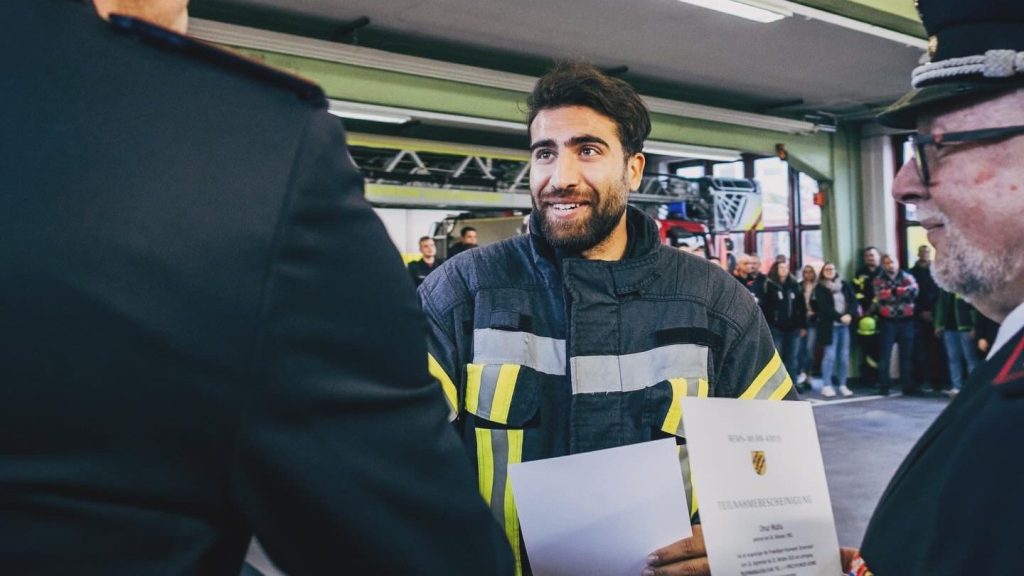
For the first three months in Germany, Masoud spoke no Persian. He knew no one, and migrating alone came with many challenges. “But with self-confidence and determination, I knew I could overcome them. In my first year, I earned my German driver’s license and secured housing. My employer supported me in difficult moments, but I still had to navigate most of the journey on my own.” From the day Masoud arrived in Germany, he felt a strong urge to help others. He documented the entire work-migration process and shared it publicly, remaining active in Telegram groups to guide newcomers. Gradually, he became more involved in community activities: connecting with Persian-speaking groups at the University of Stuttgart, collaborating with refugee-support organizations in his city, participating in consultation sessions with Refugio Stuttgart, teaching basic electronics to students through AEROSPACE LAB, and joining the local fire brigade as a volunteer, where he has now served for about a year.
Along with all of this, Masoud continues to develop his skills in electronics, technology, and embedded systems. “Between social work and my job, my time is limited, but I try to stay engaged in both areas,” he says. Masoud realized that in Germany, soft skills are just as crucial as technical expertise for achieving success. “Start by making a list of the cultural, athletic, or artistic activities you enjoy, and then join those communities. Learn the language and invest time—this is how real integration begins.”
He has spoken with many other migrants—some give up despite having strong degrees, while others manage to find their path even under the toughest circumstances. “Many Afghan migrants, despite their talent, experience, or qualifications, struggle simply because they lack guidance or a supportive structure. They often don’t know where to start, how to navigate education or the job market, or how to make the most of the system.”
Masoud began envisioning an online network for Afghan professionals—a platform designed to support newcomers, share real-life experiences, and provide clear guidance on academic, professional, administrative, and entrepreneurial opportunities. “A network like this can bridge the gap between those just starting out and those who have accumulated years of experience,” he explained. “If we build this network today, tomorrow we can take even bigger steps for Afghanistan—from online education for students to clean-energy initiatives and national-scale projects. All of this is within reach.”
 Hidden Hero