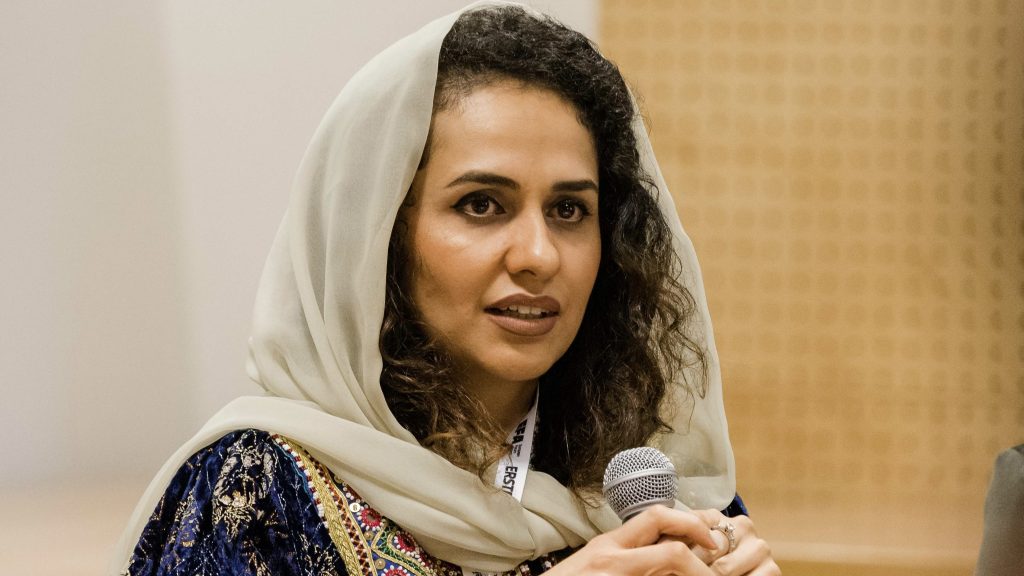
At 35, Nargis Mommand comes from a close-knit family of five siblings—two brothers and two sisters. She describes her upbringing as the foundation of her character:
“Growing up in such a family instilled in me a strong sense of responsibility, resilience, and commitment to education. These values have shaped both my personal and professional life.”
After completing her bachelor’s and master’s degrees in Social Sciences at Kabul University, Nargis began her academic career as an Assistant Professor at Kabul Education University, Bakhtar University, and Rana University.
“This experience gave me broad academic exposure and allowed me to engage with students from diverse backgrounds,” she explains.
Becoming a university professor had always been her goal.
“During my bachelor’s studies, I consistently aimed for top grades to secure opportunities for advanced education. Achieving A grades in both my bachelor’s and master’s programs enabled me to sit for the highly competitive national examination for a government university teaching position. Although it required several attempts, I eventually succeeded—demonstrating persistence and dedication.”
Alongside her academic career, Nargis completed a one-year specialization in Politics and Diplomacy through Afghanistan’s Ministry of Foreign Affairs. She also gained extensive experience in public service at Kabul Municipality, where she served as a spokesperson, strengthening her expertise in public communication and civic engagement. In addition, she worked with GIZ (the German Society for International Cooperation), contributing to curriculum design for students—an experience that further developed her skills in education policy and program development.
Later, she held senior roles at the Ministry of Defense, serving as Education Advisor to the Deputy Minister, and at the Independent Directorate of Local Governance, where she worked as Director of Media and Public Awareness, coordinating spokespersons across all 35 provinces.
An accomplished author, Nargis has written four books. One of them was recognized as the Best Book, earning her the Best Author Award from the Ministry of Information and Culture in 2018—“one of my proudest professional achievements,” she says.
Reflecting on Afghanistan before the Taliban takeover, Nargis notes that despite its challenges, the country had made meaningful progress in education, media, civil society, and women’s participation.
“Women were active as leaders, professionals, academics, and spokespersons, contributing significantly to governance and development.”
She contrasts this with the current reality:
“Today, under the Taliban, the situation is drastically different. Women have been systematically excluded from universities and most professional fields. The progress of two decades has been erased. This is not only a personal tragedy but a societal one—no country can flourish when half of its population is silenced.”
The turning point in her life came in September 2021.
“I vividly remember the day I attempted to enter the university and was refused entry. Gradually, women were completely barred from universities, leaving no female professors in Afghanistan.”
Due to her previous collaboration with GIZ, Nargis was able to relocate to Germany with her family in 2022, beginning a new chapter in safety. She continued her academic journey, earning a second master’s degree in International Organizations in Poland, strengthening her expertise in global governance and international collaboration.
Starting over in Germany was not easy.
“Everything was new—the culture, the system, and especially the language. Learning German required persistence, but I focused on rebuilding step by step.”
She reconnected with her professional field through media work, contributing to Radio Free Europe from 2022 to 2023, and later working on a project with the U.S. Department of State in Germany between late 2023 and early 2025.
After several attempts, Nargis achieved a significant milestone—becoming a university lecturer at FOM University in Germany, where she teaches communication skills in business.
“These experiences reaffirmed my belief that nothing is impossible with determination, persistence, and self-belief.”
Having achieved B2 level German and now studying at the C1.2 level, Nargis emphasizes the importance of language:
“Language is the key to integration. It enables understanding of culture, behavior, and social norms. The more I improve my German, the more I feel part of society.”
Her message to fellow Afghans is clear:
“Learn the language first. It is the bridge to connection, integration, and building a new life.”
Nargis’s contributions extend beyond academia. In 2023, she received the World Peace Award in Sweden for her volunteer efforts, and in early 2024, she was recognized as a Global Peace Ambassador in Cyprus. She also founded Farkhunda Foundation – an organization in Germany supporting refugees across Europe and educational initiatives in Afghanistan, including hidden schools and online classes for girls.
“These achievements reflect my commitment to creating impact, despite displacement and challenges,” she says.
Looking ahead, Nargis remains dedicated to academia and research.
“I aim to contribute to knowledge production, expand educational opportunities, and mentor future generations.”
She sees Germany as a land of opportunity:
“Germany offers extraordinary educational pathways. Arriving here should be seen as a chance to begin a new academic and professional journey.”
Her final message is one of strength and hope:
“Afghans are resilient and full of potential. Refugees, when given opportunities, can not only survive—but thrive and contribute meaningfully to society.”
And to all refugees, she offers simple but powerful advice:
“Believe in yourself. Pursue education, seize opportunities, and persist. Your knowledge and skills matter—and your contribution is valuable.”
 Hidden Hero