
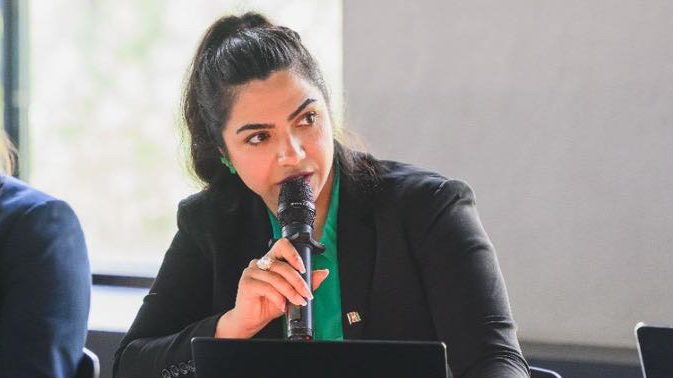
Mursal Kakar grew up in Kabul, the capital of what she describes as a land “both of deep beauty and of deep hardship.” She is one of eight siblings, with four sisters and three brothers. Her parents instilled in their children the values of strength, education, service, and equal rights—especially for girls. Mursal holds a Bachelor’s degree in Business Administration and is currently pursuing a Postgraduate Diploma in Diplomacy at the European Academy of Diplomacy in Poland. “During my studies, I developed a strong interest in policy, governance, and leadership, as I wanted to be prepared for any path and ready to face any challenge,” she says.
Mursal chose to study diplomacy because she firmly believes in the power of dialogue, building bridges, and international cooperation. “This program is not just an academic endeavor—it’s a reflection of my commitment to global governance, the rights of refugees, and post-conflict reconstruction,” she explains. “I want to learn how to lead with wisdom, negotiate with empathy, and contribute to shaping policies that uplift vulnerable communities—especially those like the one I come from.”
Mursal’s journey into diplomacy didn’t just begin with her current studies. She previously was a participant in the Youth Leadership Program at the Afghan Women’s Network—an experience she describes as transformative. “The initiative was empowering. It was more than a training; it was a movement,” she recalls. “We didn’t just talk about women’s leadership—we built the skills, drafted policies, and carved out spaces for women in civic and political life. Through policy writing, advocacy workshops, and mentorship, I witnessed how Afghan women could rise—and lift others as they did.”
Another transformative experience for Mursal was participating in the Peaceful Mind in Working Area program offered online by United Nations Institute for Training and Research in Washington, DC. “It taught me how to stay grounded under pressure, lead with mindfulness, and manage conflict in high-stress environments,” she shares. “Those lessons continue to shape the way I teach, lead, and engage—whether in classrooms, government ministries, or humanitarian settings. It refined my leadership style and equipped me with tools I carry with me everywhere.”
When Mursal moved to Germany in 2021, she was just 26 years old, in search both of safety and a new beginning, she brought with her valuable international experience from New Delhi, where she served as the Educational and Cultural Officer at the Embassy of the Islamic Republic of Afghanistan. “My work involved supporting Afghan students, promoting cultural exchange, and coordinating with Indian academic institutions,” she explains. “It was a powerful experience in soft diplomacy, where education and culture became tools to foster understanding and support our diaspora.”
Leaving Afghanistan was not a decision Mursal made lightly—it was a necessary step in response to shifting political realities. “After years of academic and professional work in both Afghanistan and India, Germany offered stability and an opportunity to grow both personally and professionally,” she reflects. “Starting over was not easy, but it was a decision rooted in courage and hope.”
Alongside her studies and travels, Mursal continues to support the Afghan community through her role as a linguist in Dari and Pashto. “I work directly with displaced individuals, especially Afghan refugees, facilitating communication in medical and legal settings,” she explains. “Translation is more than just language—it’s about trust, understanding, and restoring dignity.” In this role, she helps bridge the gap between aid providers and refugees, ensuring that vital information is conveyed clearly and compassionately. “In these moments, I see myself as both a communicator and an advocate.”
According to Mursal, Afghan refugees in Germany face both valuable opportunities and significant challenges as they work to rebuild their lives. “While the country offers safety and a structured environment, integration can be hindered by language barriers, mental health needs, and complex administrative processes,” she notes. “To ensure meaningful and lasting integration, it is essential to develop comprehensive support systems—including language acquisition, access to quality education, employment pathways, and inclusive community engagement.”
Mursal emphasizes that integration is not a one-sided effort; it requires mutual understanding, openness, and long-term commitment. “Afghan refugees should not be viewed solely through the lens of vulnerability,” she says. “They must be recognized for their resilience, their talents, and their potential to contribute meaningfully to society.”
Living among diverse communities in Germany has been an enriching experience for Mursal. “I’ve found warmth and support,” she says, “but also moments of misunderstanding and cultural friction.” She appreciates Germany’s structure, its respect for the rule of law, and its commitment to multiculturalism. At the same time, she actively shares her Afghan identity with those around her, striving to build connections where differences might otherwise create distance. “It’s about creating dialogue, not division,” she adds.
Life has recently been full and fulfilling for Mursal as she balances her Master’s studies with professional work and her ongoing commitment to refugee support and women’s rights advocacy. “This is a phase of transition—building new networks, settling into a new country, and continuing to serve,” she reflects. “Both personally and professionally, I’m growing, learning, and stepping more fully into my purpose.” After completing her studies, Mursal aims to work with international organizations focused on refugee policy, women’s empowerment, and post-conflict development.
For new Afghan arrivals she says: “Your past does not define your future. You have strength, knowledge, and value. Let no one tell you otherwise.” She adds: “Invest in peace. Empower women. Respect refugees. Value education. The world does not need more division; it needs understanding, and it starts with how we treat one another every day.”
If she has learned anything from her journey, it’s that no story is ever finished. “I am still writing mine, with every class I teach, every student I mentor, and for every refugee I translate. I walk forward with purpose, and I carry Afghanistan in my heart, wherever I go.”

